Smooth filing performance depends on more than a thick cover. For Lever Arch Files, the metal mechanism carries the real working pressure every time users open the lever, add documents, remove pages, or store a full file upright on a shelf. When the mechanism is weak, even a good-looking file can quickly create complaints such as loose rings, uneven closing, paper slipping, or damaged punched holes.
A lever arch file is often used for invoices, contracts, school records, training files, warehouse documents, and archive materials. These documents are not light when they accumulate. ISO 216 defines A4 paper as 210 mm × 297 mm, and ordinary 80 gsm office paper weighs about 5 grams per sheet. A file holding 400 sheets may carry nearly 2 kilograms of paper before adding the weight of the cover, metal parts, and label area.
That pressure is transferred to the lever unit, rivets, spine board, compressor bar, and ring alignment. If any part is unstable, the file may still stand on a shelf, but the user experience will decline after repeated operation.
| Mechanism Part | What Buyers Should Check | Quality Risk If Ignored |
|---|---|---|
| Metal lever unit | Smooth opening and firm closing | Rough movement or weak locking |
| Ring alignment | Even contact between both sides | Paper holes may tear |
| Rivets | Tight fixing to cover board | Mechanism may loosen |
| Compressor bar | Firm paper pressure | Documents may slide |
| Rado slot | Shelf stability and closure support | File may open or deform |
A small defect in a file mechanism can affect a full carton of finished goods. Buyers may not notice the issue from product photos, but end users will notice it immediately when the lever feels loose or the rings do not close evenly. This is why strong file mechanisms are important for export stationery orders.
For procurement teams, mechanism testing should include repeated opening, ring closing accuracy, rivet stability, and paper-holding pressure. A lever that feels too stiff can reduce usability, while a lever that feels too soft may not hold documents securely. Good mechanism design should balance strength, smoothness, and long-term consistency.
The metal clip cannot work alone. A strong mechanism needs a stable cover board and reinforced spine to hold it firmly. If the board is too soft, the rivet area may deform after heavy loading. If the spine is too narrow for the document capacity, the file can bend during storage or packing.
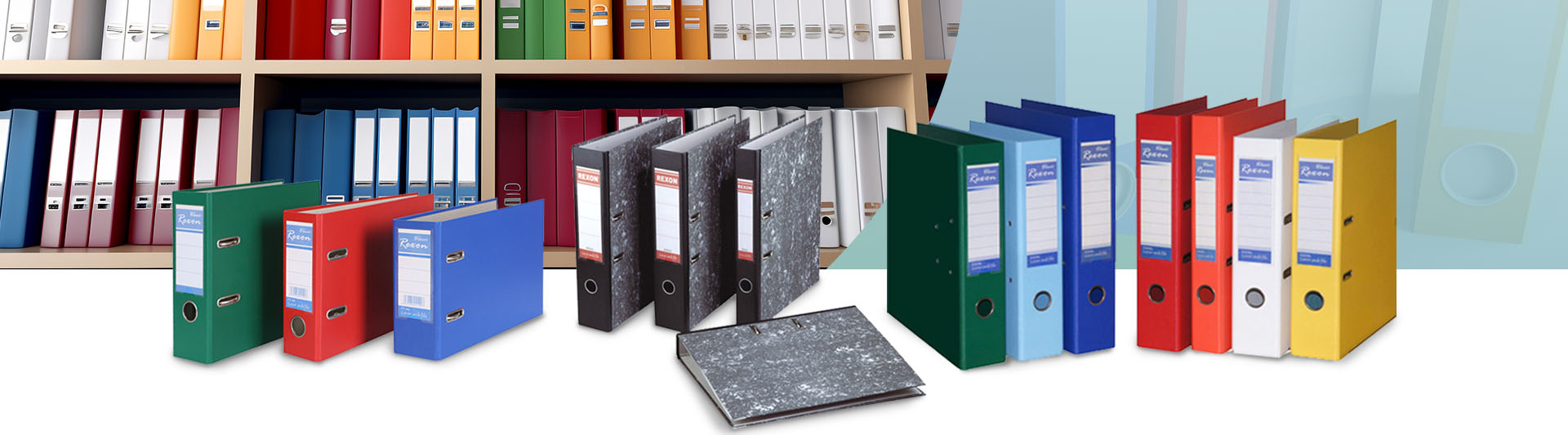
REXON’s product range includes A4 lever arch files, PVC lever arch files, marble lever arch files, Paper Files, Ring Binders, suspension folders, and filing hardware accessories. For file manufacturing, this category combination is useful because metal parts, paperboard, cover materials, and filing structures can be matched together during development rather than treated as separate items.
Lever arch files are often stored upright. Users pull them from shelves by the spine hole, open them on desks, add new documents, and return them to storage. A weak mechanism may let documents shift inside the file, making the cover harder to close. Over time, this affects shelf neatness and document protection.
A stable mechanism keeps pages aligned and reduces strain on punched holes. It also helps the file maintain a neat appearance after many cycles of use. For office supply channels, this detail matters because buyers want products that feel reliable after purchase, not only attractive on a catalog page.
Several small parts improve the value of a lever arch file. A compressor bar helps keep documents flat. A finger hole supports easy shelf retrieval. Rado slots help keep the file closed when stored. Metal corner protectors can reduce edge damage in some designs. Clean rivet fixing improves the overall finish.
When these details are consistent, the file looks more professional and performs better in daily handling. For a lever arch file supplier, reliable hardware selection can help customers position their product range from basic office use to higher-capacity archive storage.
A good sample is not enough. Buyers need the same mechanism performance across repeated shipments. Our team pays attention to material selection, metal fitting, cover cutting, rivet fixing, spine alignment, and packing protection. The goal is to reduce visible defects and hidden mechanical problems before goods leave the factory.
For large orders, buyers should confirm mechanism type, spine width, board thickness, surface material, color standard, label design, and carton packing before production. These details help control both product quality and delivery stability.
Strong mechanisms make lever arch files easier to use, safer for document storage, and more reliable for repeated orders. The best file is a balanced combination of metal strength, board support, accurate assembly, and protective packing. With a complete filing product range and practical manufacturing support, REXON can help buyers build stable stationery programs for office, school, archive, and wholesale supply channels.
