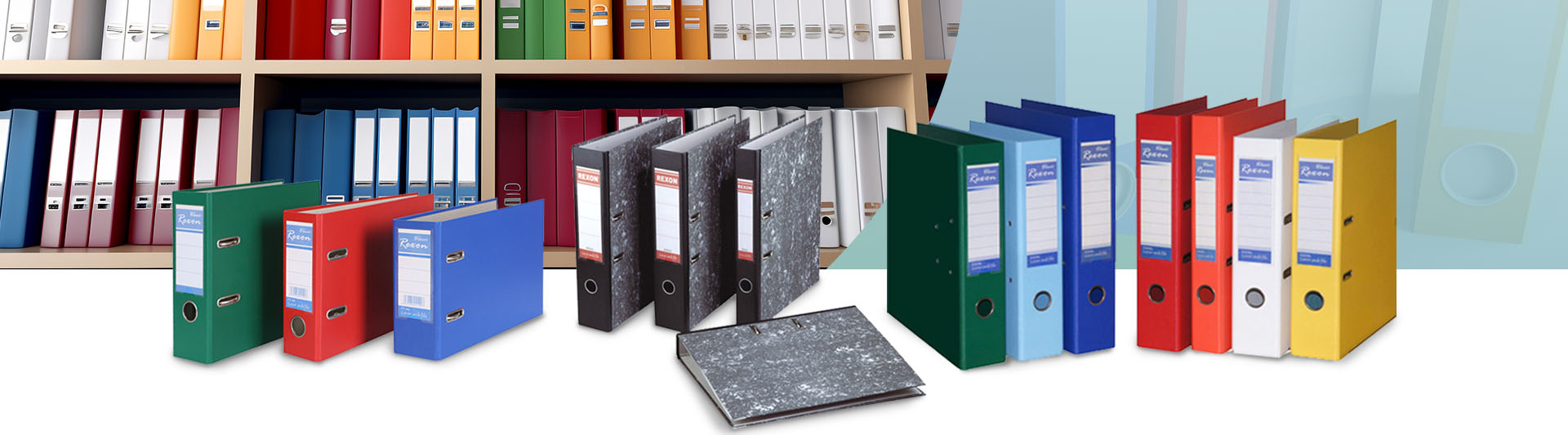
A Lever Arch File may look simple from the outside, but reliable performance depends on disciplined material selection, accurate mechanism assembly, and stable finishing control. At REXON, lever arch files are not treated as generic stationery items. They are built as long-use document management tools that must open smoothly, hold paper securely, resist daily wear, and keep a professional appearance across repeated handling. REXON presents itself as a specialized manufacturer of lever arch files and mechanisms, with roots going back to 2001 and a product range centered on office filing solutions.
In practical use, customers care about more than color or size. They look for stable board strength, neat edge wrapping, a mechanism that closes firmly, corrosion-resistant hardware, and consistent file dimensions across bulk orders. REXON highlights durable cardboard structures, metal arch mechanisms, and wipe-clean outer surfaces such as polypropylene or PVC on selected models. It also offers multiple formats including A4, A5, and foolscap, with different board weights and spine widths depending on application.
Before a file is formed, the factory must match materials to the product positioning. The rigid board creates body strength. Surface paper, marble paper, PVC, or polypropylene gives the file its appearance and wear resistance. Steel components support the locking system, slide-in plate, finger ring, and related fittings. On several REXON product pages, the board specification reaches 1000 gsm, 1200 gsm, or 1500 gsm depending on model, which shows how structure is adjusted for different durability targets and storage capacity.
| Component | Common Material Direction | Main Function |
|---|---|---|
| Board core | Grey board or heavy cardboard | Gives rigidity and shape retention |
| Outer wrap | PVC, PP film, printed paper | Improves surface durability and visual finish |
| Inner lining | Paper or laminated sheet | Supports a neat inside appearance |
| Metal parts | Steel mechanism and fittings | Holds punched documents securely |
| Accessories | Label holder, finger ring, rado slots | Improves identification and handling |
The first stage in the document file manufacturing steps is cutting the board to exact dimensions. This stage determines whether the final file will stay square, stack properly, and close neatly. Factories usually prepare front board, back board, and spine sections according to the target size and ring capacity. Precise cutting matters because even small size deviation can lead to poor edge wrapping, misaligned mechanisms, or label pockets that do not sit correctly.
After the board is cut, the exterior material is applied. For some models this can be marble paper plus PVC spine reinforcement, while for others it can be full PVC or polypropylene wrapping. The purpose is not only appearance. The outer layer also improves scratch resistance, wipe-clean performance, and moisture tolerance. REXON specifically notes durable covers and easy-clean surfaces on its lever arch file range, which is especially important for files used in schools, offices, archives, and other high-contact environments.
Once the wrapped board is ready, the sheet is creased at controlled positions so the file can fold cleanly without surface cracking. Spine lines must be straight and repeatable across every batch. In larger capacity files, this step becomes even more important because the spine carries more weight when the file is filled with documents. A well-formed spine helps the product keep its shape during transport, shelving, and repeated opening.
The file mechanism manufacturing process is the heart of the product. The lever arch mechanism is fixed onto the spine section with matching hardware. Depending on the design, the file may also include slide-in steel plates, rado slots, finger rings, and removable mechanisms. REXON repeatedly emphasizes its specialization not only in lever arch files but also in the mechanism itself, which is a strong advantage for manufacturing control because body construction and hardware matching can be developed together instead of treated as separate parts.
After the main mechanism is set, workers or semi-automatic stations add label holders, welded spine pockets, edge turn-ins, and internal reinforcements. This is where the product becomes easier for end users to handle in real office conditions. A finger ring affects shelf retrieval. A label window affects quick classification. Rado slots improve stability when the file is standing upright. These may look like small additions, but they strongly influence the everyday value of the finished file.
No serious office file factory production system ends with visual checks alone. The finished file should be tested for mechanism opening and closing smoothness, rivet security, board alignment, wrap adhesion, edge finish, and overall dimensional consistency. REXON states that quality control runs through raw material inspection to final shipment preparation, which is exactly what buyers should expect from a mature factory. A file that looks acceptable at first glance can still fail later if the mechanism loosens, the board warps, or the cover separates after repeated use.
The most dependable lever arch file making process is not about one dramatic production step. It comes from control at every stage. Material thickness must match the target market. Surface adhesion must stay stable. The mechanism must align perfectly with the spine. Accessories must be installed consistently. Packaging must protect corners and edges during export transit. REXON’s specialization in this category, broad model range, and focus on durable materials position it well for buyers who value long-term consistency rather than one-off appearance.
Understanding lever arch file production helps buyers compare suppliers more accurately. It becomes easier to judge whether a quote reflects material grade, hardware quality, surface finish, and process stability. It also helps when discussing private label development, board thickness, mechanism type, spine width, or archive-heavy use cases. A manufacturer that understands both product structure and line control can usually respond faster to customization while maintaining batch consistency.
A high-quality lever arch file is the result of coordinated engineering between rigid board conversion, surface wrapping, spine forming, mechanism fitting, accessory assembly, and full-process inspection. When these stages are handled well, the product delivers clean appearance, strong document holding power, and reliable daily performance. For customers sourcing filing products at scale, a specialist such as REXON offers an advantage through focused category experience, durable material choices, and manufacturing knowledge that supports stable output over time.
