Even in an increasingly digital workplace, physical filing still plays an important role in contracts, finance records, HR files, compliance documents, project paperwork, and client presentations. The reason is simple: records still need to be timely, accurate, accessible, and usable, and a well-structured filing system directly supports that goal. U.S. government records guidance also notes that good records management improves retrieval speed, reduces operating costs, and helps control the growth of paper records. Industry estimates still show that the average office worker uses about 10,000 sheets of copy paper per year, while 45% of office paper may be discarded by the end of the day. That makes folder selection more than a stationery choice. It is an efficiency decision.
In most offices, the most commonly used folders are not all the same. Different departments use different formats because document volume, access frequency, storage location, and presentation needs vary. A finance team may need archival strength and category labels. A sales team may need neat presentation folders for proposals. An administrative department may need quick-sort suspension files for cabinets. Choosing the right folder type helps reduce search time, improve consistency, and protect documents from wear.
Standard paper folders remain the most widely used option for daily document sorting. They are simple, lightweight, cost-effective, and suitable for invoices, quotations, internal forms, meeting notes, and temporary project paperwork. Their biggest advantage is speed. Staff can create a quick filing structure by department, month, customer, or project code without adding unnecessary bulk. For offices that handle a steady flow of paperwork, this type of folder is often the basic building block of the filing system.
These folders work best for active documents that need to be reviewed often but do not require heavy-duty long-term storage. They are especially common in general administration, accounting support, and purchasing workflows where documents move between desks before final archiving.
Suspension files are one of the most practical choices for offices that rely on filing cabinets. They hang on rails and allow files to slide for fast retrieval. This format supports classified storage and quick lookup, which is why it is commonly used for personnel records, contract files, tax documents, case files, and customer account paperwork. On Rexon’s product pages, filing cabinet suspension files are described as a system made up of hanging rails, folders, and labels, designed to improve classification, retrieval efficiency, and space utilization.
For offices with limited floor space, suspension files help organize a large number of records neatly inside drawers instead of stacking them on shelves or desks. They are especially useful when documents must remain in sequence by alphabet, project, or date.
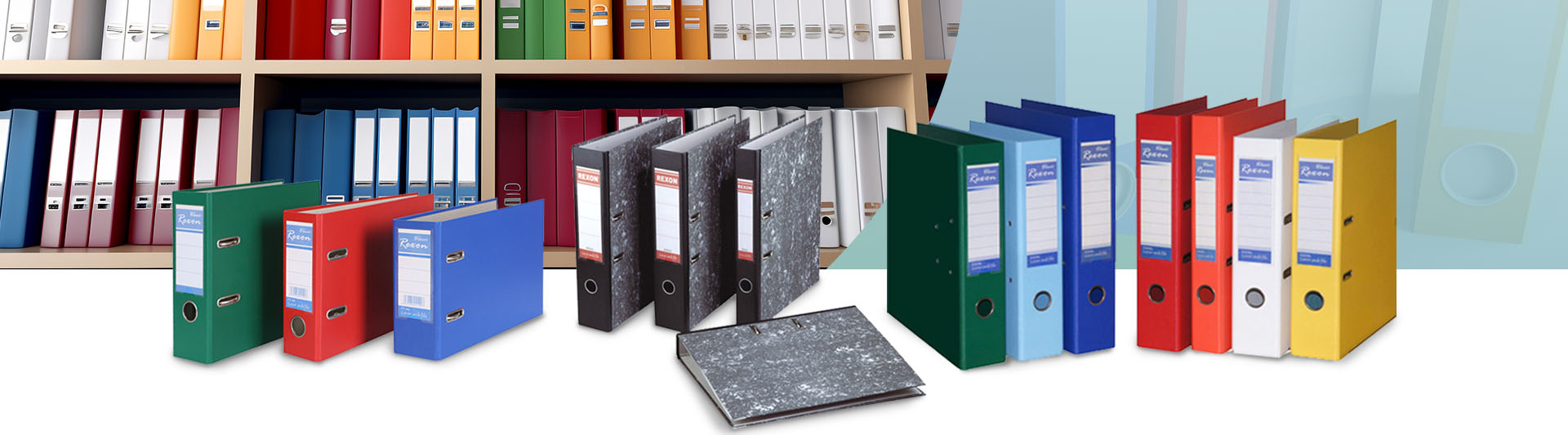
lever arch files are among the most common office folders for large-volume document storage. They are widely used for policies, manuals, tenders, accounting records, contracts, technical files, and archived documentation that must stay complete and easy to browse. Their strong mechanism and structured spine make them suitable for repeated handling and shelf storage.
This is one of Rexon’s core product categories. Rexon states that its main product range includes lever arch files, and the company specializes in lever arch files and related mechanisms. For offices that manage dense paper files, this type offers better document security and a more professional archive appearance than thin folders.
Ring binders are commonly used when documents need to be updated regularly. Training manuals, product catalogs, SOP files, presentation materials, school administration records, and departmental reference documents often use binders because pages can be added, removed, and reordered easily. Compared with lever arch files, ring binders are often preferred for working files rather than final archives.
Rexon also lists ring binders as one of its main manufacturing categories, which reflects their stable demand in office and institutional environments. For teams that revise documents frequently, binders remain one of the most flexible formats available.
Expanding files are useful for portable, categorized storage. Offices often use them for receipts, traveling paperwork, temporary customer files, bid documents, or multi-stage approvals that need to be grouped but carried between meetings or departments. Their divided sections help separate content without requiring many individual folders.
This type is especially common in sales, procurement, and project coordination because one file can hold multiple subcategories in a compact format. It is less suitable for permanent archives, but highly effective for short-cycle document management.
Presentation folders are common in client-facing office work. They are used for proposals, onboarding packs, marketing collateral, contracts ready for signing, and handover documents. In many organizations, this folder type serves both practical and branding purposes. A well-made presentation folder keeps materials aligned while also improving visual consistency during meetings.
Rexon’s product range includes folders and high-capacity document wallets, and the company also offers customization of size, color, and logo. That is useful for offices that want filing products to align with internal identity standards or external presentation needs. (REXON)
| Office need | Most suitable folder type | Why it is commonly used |
|---|---|---|
| Daily paperwork sorting | Standard paper folder | Fast, economical, easy to label |
| Cabinet-based records | Suspension file | Efficient classification and retrieval |
| High-volume archive storage | Lever arch file | Strong structure and large capacity |
| Frequently updated manuals | Ring binder | Pages can be replaced easily |
| Portable categorized documents | Expanding file | Multiple sections in one unit |
| Client proposals and handover packs | Presentation folder | Neat appearance and brand value |
No single folder can solve every filing problem. Offices usually combine several types because document workflows are different. Records that must be stored for years need stronger construction. Documents used every day need quick access. Client materials need better presentation. Temporary files need portability. The most efficient filing systems are built by matching folder design to document behavior rather than forcing every document into one format.
That is also why product consistency matters. When a company standardizes folder sizes, labeling areas, colors, and mechanisms, employees file faster and retrieve documents with fewer errors. This is especially important in environments where record control affects service quality, compliance, or operational speed. Records management guidance emphasizes that good systems support accessibility, cost control, and better business decisions. (U.S. Department of the Interior)
For buyers evaluating folder solutions from a manufacturing perspective, Rexon has several clear strengths. The company states that Jinye Stationery was founded in 2001 and manufactures lever arch files, ring binders, folders, elastic paper boxed products, and hanging files. Rexon also says it serves customers in over 30 countries, while most technicians and managers have more than 20 years of specialized experience in the industry. Its product pages further show customization support for folder size, color, and logo, which is valuable for private label programs and standardized office supply projects. (REXON)
This combination matters because office filing products are not only about appearance. They depend on mechanism quality, dimensional accuracy, cover durability, printing consistency, and reliable supply. Rexon’s own quality-control content highlights visual inspection, dimensional inspection, and printing alignment checks before shipment, which speaks directly to the needs of offices and distributors looking for dependable filing products. (REXON)
The folders most commonly used in offices are standard paper folders, suspension files, lever arch files, ring binders, expanding files, and presentation folders. Each serves a different purpose, from daily sorting to long-term archiving and professional document presentation. The best choice depends on document volume, storage method, update frequency, and how often files need to move between people or departments.
For companies building a more organized office filing system, Rexon offers a practical product range backed by long manufacturing experience, category depth, and customization capability. A well-matched folder system does more than store paper. It helps offices work faster, look more professional, and manage records with greater control. For tailored filing solutions, product selection advice, or custom project support, Rexon can provide direct guidance based on your document structure and market requirements.
