When buyers ask about the standard board thickness for a commercial-grade Lever Arch File, the most practical answer is this: 2.0 mm is the most commonly accepted market benchmark, while 2.2 mm is widely used for heavier-duty models and some lighter economy files may use thinner board. In other words, the industry usually works within a range rather than a single universal rule, but for dependable office and archive use, 2.0 mm has become the mainstream reference point.
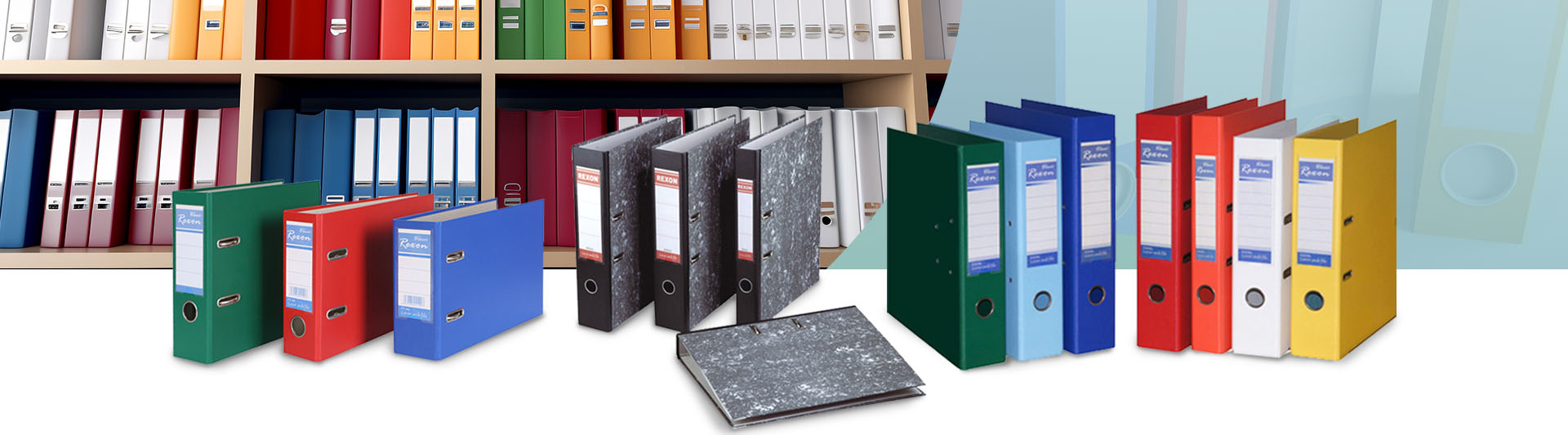
That matters because board thickness directly affects how the file performs in daily use. A lever arch file is not just a paper cover around a mechanism. It is a structural product that must support the metal mechanism, resist bending on shelves, protect documents during repeated handling, and maintain its shape under load. Once board thickness drops too far, the spine can deform more easily, corners wear faster, and the file loses the rigid feel expected in commercial environments. Rexon positions its lever arch files around long-lasting durability, tough cardboard construction, wipe-clean outer surfaces, and corrosion-resistant internal metal parts, which aligns well with the performance needs of commercial filing systems.
Across current market references, 2.0 mm repeatedly appears as the standard construction thickness for lever arch files intended for regular office and institutional use. Multiple product references list 2.0 mm cardboard for 75 mm class lever arch files, especially in laminated or PP-coated formats. That consistency is why many manufacturers and buyers treat 2.0 mm as the practical standard for commercial-grade supply rather than a casual specification choice.
A thicker 2.2 mm board is also common when the product is positioned as heavy duty, extra durable, or better suited to frequent handling and fuller shelf loads. This upgrade is especially relevant when the file will be used in active records rooms, government offices, education systems, or other environments where binders are pulled, opened, and re-shelved many times.
Commercial-grade lever arch files are usually discussed together with spine width and paper capacity. A common reference in the market is a 75 mm spine holding up to 500 sheets of 80 gsm paper. Some wider models around 78 to 80 mm can reach about 500 to 600 sheets, and extra-capacity versions may go higher depending on mechanism design and file format. This is why board thickness should never be evaluated alone. A 2.0 mm board paired with a suitable mechanism and reinforced design can perform very well, while an oversized file with weak board can still fail early.
For A4 filing, the paper itself is standardized at 210 × 297 mm, so the file body must provide enough margin for hole punching, page turning, labeling, and shelf handling. Because commercial files often carry hundreds of sheets, the stiffness of the board becomes part of the overall load-bearing system, not just the outer appearance.
| Use level | Common board thickness | Typical positioning |
|---|---|---|
| Light office use | 1.8 mm to 2.0 mm | Economy or lower-volume filing |
| Standard commercial use | 2.0 mm | Mainstream office and institutional supply |
| Heavy-duty commercial use | 2.2 mm | Frequent handling, fuller shelves, longer service life |
The table above reflects common market practice rather than a single mandatory global standard. In sourcing discussions, this is often the most useful way to evaluate thickness because it connects the figure to real use conditions.
A commercial lever arch file should be evaluated as a complete product system. Buyers should also review:
board density and stiffness
PP or paper lamination quality
metal mechanism stability
rivet and fitting strength
spine width and true sheet capacity
edge protection and surface wear resistance
For example, some market listings pair 2.0 mm board with about 1290 gsm coated cardboard, while heavier constructions reach 2.2 mm and 1400 gsm. Those combinations show that caliper and board weight often work together to deliver durability.
This is where Rexon has a useful manufacturing advantage. The company specializes in lever arch files and mechanisms, operates with advanced production equipment, has over 108 employees, exports to more than 30 countries, and notes that many of its technicians and managers have more than 20 years of industry experience. On the product side, Rexon highlights durable cardboard covers, wipe-clean polypropylene wrapping, customizable formats, and metal parts designed for long service. Those are practical strengths for buyers comparing not only thickness, but also production consistency and long-term usability.
For most commercial projects, 2.0 mm board is the safest standard starting point. It offers a familiar market specification, solid shelf performance, and compatibility with common 75 mm filing formats. When the file is expected to carry heavier loads or face rougher daily handling, 2.2 mm becomes a stronger option. When price pressure is high and usage is lighter, a thinner construction may still be acceptable, but it should be chosen carefully and matched with the real filing volume.
There is no single worldwide rule that says every commercial-grade lever arch file must use one exact board thickness. In real market practice, 2.0 mm is the standard reference most buyers recognize, while 2.2 mm is a common upgrade for heavier-duty performance. The best choice depends on filing load, shelf conditions, handling frequency, and the quality of the full construction.
Rexon offers lever arch file manufacturing experience, customization support, and durable product construction for businesses that need reliable filing solutions with stable quality. For projects requiring the right balance of board thickness, spine width, mechanism type, and finish, our team can help recommend a specification that fits your market and usage needs.
