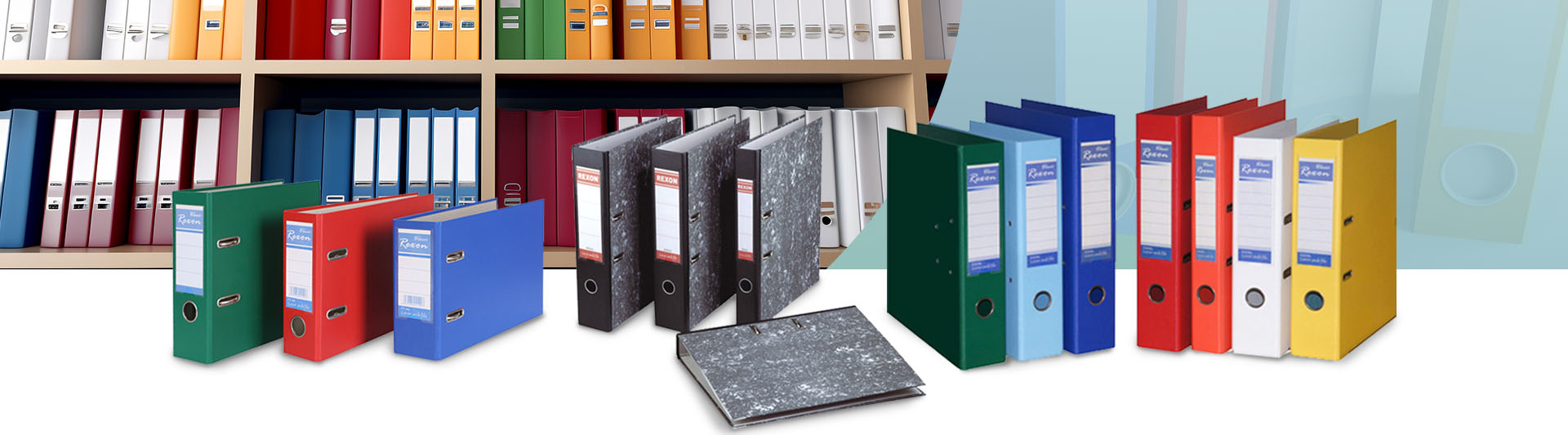
Lever Arch Files and Ring Binders are two of the most widely used filing solutions in offices, schools and commercial environments. While both help organize paperwork efficiently, they differ in structure, capacity, durability and user experience. Understanding these differences allows buyers to choose the format that best supports daily document handling, storage needs and workflow efficiency. This article provides a clear comparison to help you make an informed choice, and also highlights why many businesses rely on professional stationery manufacturers such as REXON for long-lasting filing products.
lever arch files use a strong metal lever mechanism with two large rings mounted on a reinforced spine. This system opens widely with a single motion, allowing users to insert or remove hundreds of sheets quickly. The rings are designed to lock firmly, keeping the stack tightly aligned even when the file is full.
Ring binders typically feature a two-ring or three-ring design. The mechanism is lighter and suited to smaller volumes of documents. Pages turn more freely, which is practical for documents that must be accessed frequently, such as manuals or training materials. However, the opening mechanism is usually slower because each ring must be pressed to open.
Lever arch files are known for their superior capacity. They can often hold between 500 and 700 sheets depending on the spine width. This makes them ideal for archiving long-term records, accounting documentation or project folders that accumulate many pages.
Ring binders hold far fewer sheets. A standard binder usually accommodates 150 to 300 pages. While this lower capacity makes them less suitable for heavy documentation, it is appropriate for lighter filing tasks or materials that need regular updates.
Below is a simple comparison:
| Feature | Lever Arch File | Ring Binder |
|---|---|---|
| Typical Sheet Capacity | 500–700 | 150–300 |
| Opening Mechanism | Lever-operated metal clamp | Push-to-open ring system |
| Best Use | Long-term storage, large volumes | Daily use, lightweight documents |
Lever arch files are generally built with a reinforced board structure, metal edges and a heavy-duty spine. This makes them strong enough to withstand constant opening, weight pressure from large stacks of paper and long-term shelf storage. Many also include a metal finger hole for easy retrieval from cabinets.
Ring binders have lighter construction and are more prone to wear when holding heavy loads. The covers may bend over time, and rings can become misaligned if overfilled. Although perfectly suitable for everyday use, they are not usually the first choice for document archiving.
A major advantage of lever arch files is their one-touch lever mechanism, allowing users to open the metal clamp instantly. This saves time during filing, especially when handling thick documents. The pages are also compressed tightly, reducing bending and improving document stability.
Ring binders are more comfortable for browsing and page-turning. With smaller rings and lighter covers, they offer a smoother navigation experience. This makes them popular for presentations, instruction guides or classroom materials.
Because lever arch files require stronger materials and a reinforced mechanism, they tend to have a higher unit cost. However, their durability often leads to a longer lifespan, which makes them cost-efficient for heavy users.
Ring binders have a lower upfront cost and remain widely accessible. For environments where documents change often and do not require archival strength, they offer a budget-friendly solution.
Suitable for businesses or institutions managing large volumes of paperwork such as financial statements, procurement records, long-term project documentation or legal files. Their strength and capacity make them an excellent fit for storage rooms and archival systems.
Ideal for work manuals, training content, small project files, daily classroom materials or presentation packets. Their lighter construction supports frequent handling and page-turning.
When comparing both options, the choice depends on your document volume, frequency of use, storage conditions and long-term durability requirements. Lever arch files excel in capacity and strength, while ring binders provide flexibility and ease of access. Many companies use both types for different purposes within the same workspace.
If you require reliable, well-engineered filing products, consider manufacturers that focus on quality materials and robust construction. REXON offers a range of office and commercial stationery solutions designed for long-term use. Their professional approach makes them a trusted choice for businesses looking to improve document organization and storage efficiency.
